

I went to Cape May earlier this month, a place I’ve visited nearly every fall since 2018. The birding is unlike anywhere else I’ve been. There’s something in the air, and that thing is migration. Movement surrounds you—every kind of bird comes to this crossroads at the southern tip of New Jersey, between the Atlantic Ocean and Delaware Bay. If you spend enough time visiting, and listen to the local birders, you begin to understand the calculations that birds have to make—wind, weather, time of day, time of year—as they face large water crossings in their southbound journeys. Humans appear static to me there, stagehands in this continent-wide drama. But it’s not only birds, it’s insects too—especially monarch butterflies.
Monarchs make their own incredible migrations, and many concentrate along the Atlantic coast in late September and early October, using the coast as a guide while going south. Weighing less than a paper clip, some will travel up to 3,000 miles from the northern United States to the Trans Volcanic Mountains of central Mexico, in the space of two months. (These are the eastern monarch butterflies; the western ones overwinter along California’s coastline.) Millions of butterflies gather at a few colonies in the winter—far fewer than there used to be, but still enough to bend the branches of the fir trees they gather on.
How do they do it? As the author Dan Fagin wrote in the New York Times last year:
Most of the time, they rely on a system that orients them in relation to the sun, keeping them pointed south throughout the day by compensating for the sun’s movements across the sky. When clouds get in the way, monarchs switch to a backup compass that relies on ultraviolet light to detect the angle of the Earth’s magnetic field.
Their twin compasses usually keep migrating monarchs headed in the correct general direction. But how the butterflies manage to locate the same isolated colonies their great-great grandparents occupied the year before is a longstanding mystery.
But part of that mystery, I would learn, is beginning to be solved.
For over three decades, the Cape May Bird Observatory’s Monarch Monitoring Project, established in 1990, has gathered data on the monarchs moving through Cape May in the fall. They do that in two ways.
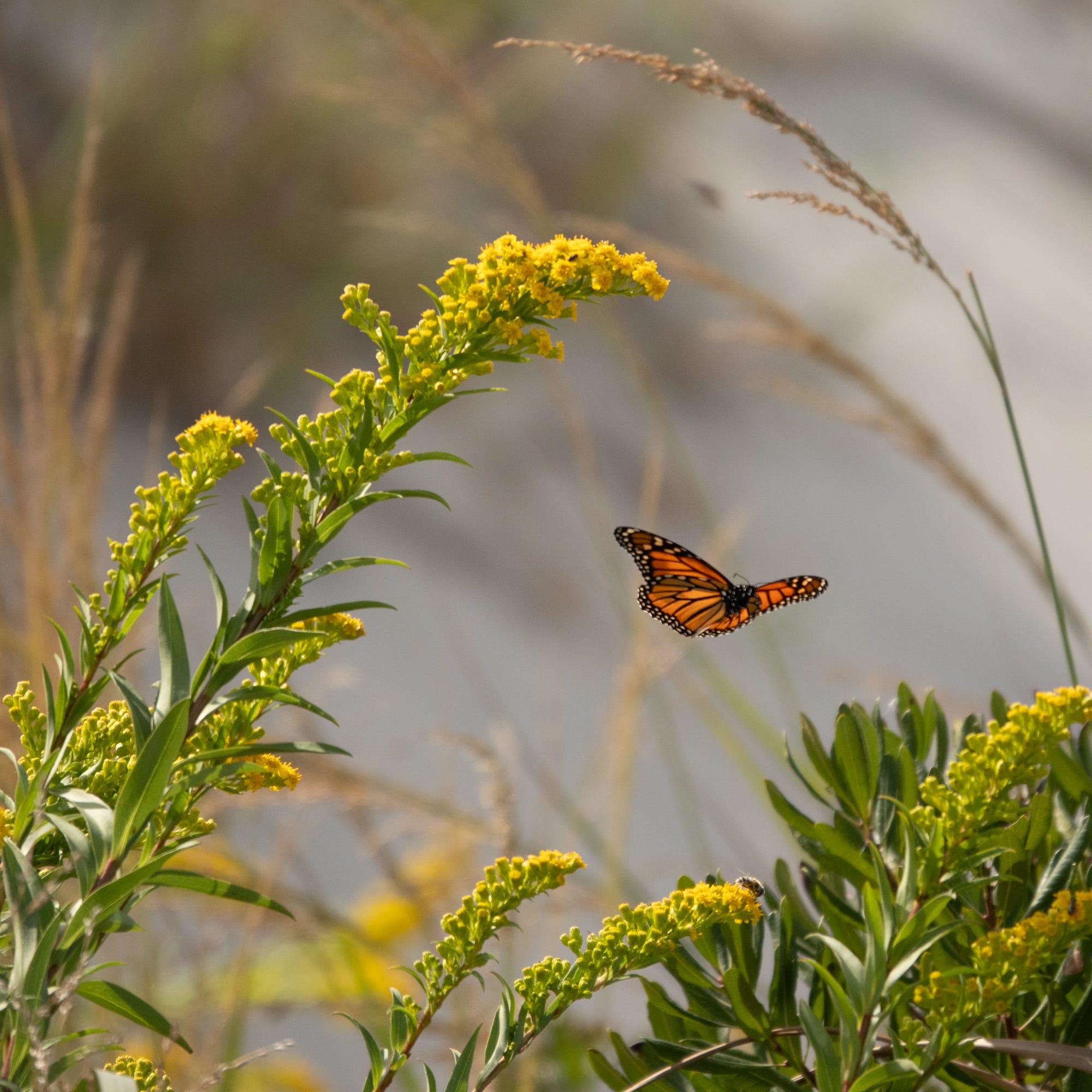
The first is with point counts, in which all monarchs (as well as other migrating insects) are counted at a fixed location in the dunes of Cape May Point three times a day—two, five, and eight hours after sunrise. Each count is 30-minutes long. During peak migration, the monarchs travel northwest down the line of dunes, sometimes stopping to refuel on goldenrod or butterfly bush or resting in the pines.
On our first morning in Cape May, my wife Angie and I went to the platform where was the count is held. Right away I could see we had chosen the right time. Monarchs were floating by us, many of them only several feet above the dunes. A light wind came out of the northwest, which meant the butterflies weren’t going to cross Delaware Bay—they needed northeast winds to help push them across.
I was told that their migration used to peak in late September, but it seems to have shifted to the first week of October. It was October 9. This year, the nor’easter that slammed the region at the end of September may have delayed it further.
Right at noon, three researchers with the Monarch Monitoring Project returned for the second of three counts that day. It was all hands-on deck. By now the monarchs were flowing like a orange-and-black river through the dunes. Dragonflies too—hundreds of common green darners and black saddlebags. One person counted monarchs with a clicker and another the dragonflies. They called out the less common sightings: eight additional species of butterflies, including an especially striking pipevine swallowtail, and five other types of dragonflies. In half an hour, they counted 863 monarchs, 499 green darners, and 404 black saddlebags. (Eventually, the total number of monarchs for the day was 1,354.)
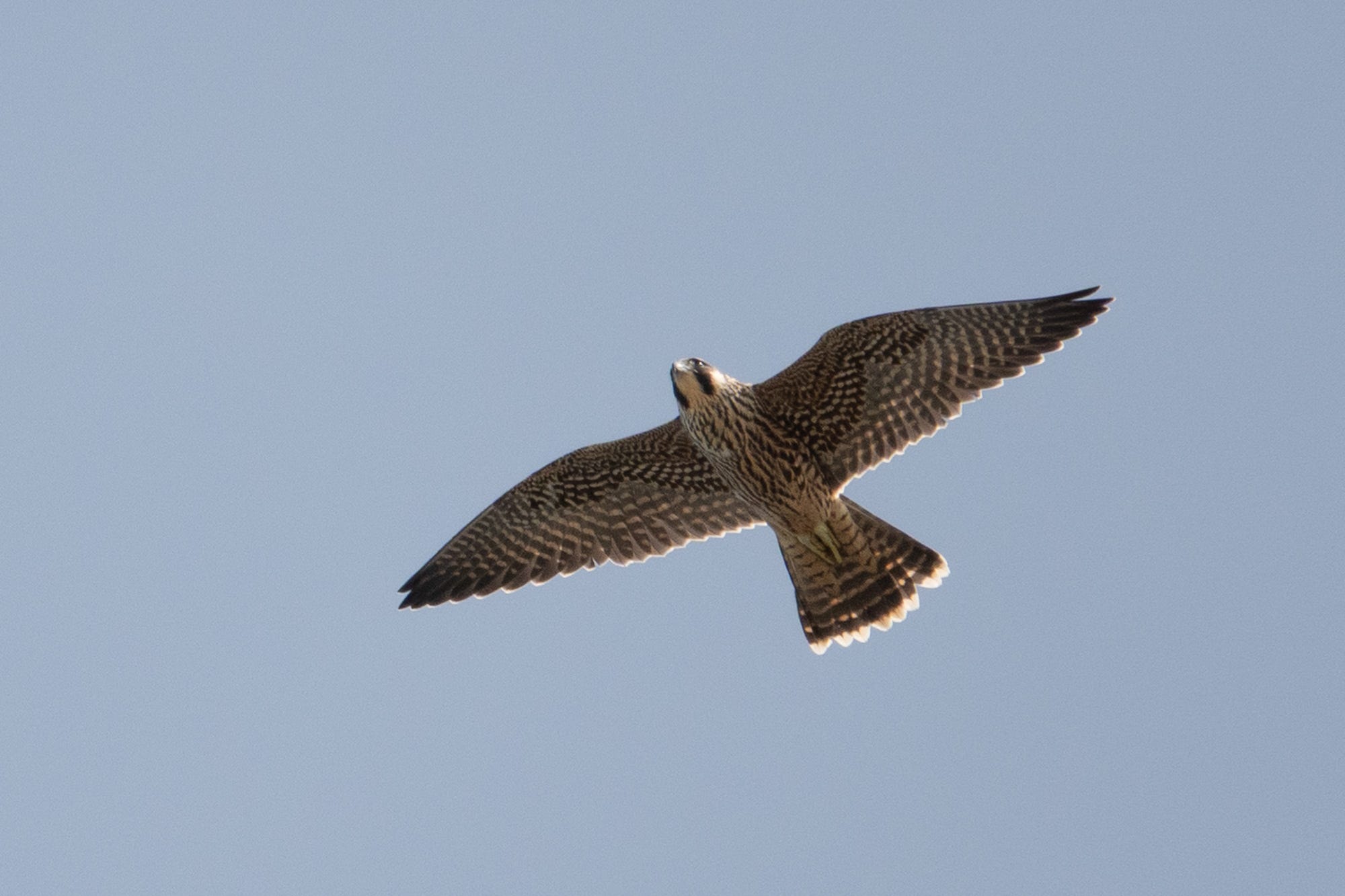
I find it hard to describe the experience, but it was dreamlike. Every time I turned my head there were butterflies and dragonflies either side of me, drifting past. Some were close enough to touch; I was inside the river. Meanwhile, birds were constantly flying past us and over our heads too, including a succession of peregrine falcons that, once they drew within sight of the end of the land, just powered out over the bay toward Delaware.
The Monarch Monitoring Project posts its data to the website Trektellen, which is a site predominantly devoted to bird migration counts, of which Cape May Bird Observatory has three. The comments section for this 30-minute slot nicely sums up the experience: “wow.”
The second way that the Monarch Monitoring Project—along with other researchers—studies these butterflies is by tagging them. And here’s where it gets even more incredible.
The overwintering sites for monarch butterflies, high in those mountains of central Mexico, were not discovered by Western researchers until January 1975. Scientists perfected a sticker-tag that could remain stuck to a delicate butterfly wing, and over the following decades, began to piece together the monarch migration puzzle. Soon after the Monarch Monitoring Project began fieldwork in 1991, it began tagging thousands of monarchs per season. It was assumed that the Atlantic coast monarchs overwintered in Mexico, too, but it had never been proven. In 1995, the first monarch from Cape May was recovered in those mountains.
The payoff—a few recoveries among thousands tagged—speaks to the perils of their migration. They do it, however, because for the longest time those mountains offered the monarchs perfect weather—cool enough for them to enter a low metabolic state, but not too cold that they freeze. No more than one in four survive the trip, though, Dan Fagin reported in the Times, the rest succumbing to “unfavorable winds, hungry birds, vehicle traffic or sheer exhaustion…”
Nowadays they face habitat loss every step of the way. Illegal logging and climate change have reduced the fir forests they occupy in the winter. Once temperatures warm in the spring and those same monarchs head north, they spread out across the Midwest, laying eggs on milkweed as they go; subsequent generations push as far north as Canada, where the cycle starts over in the fall. But their breeding grounds have shrunk dramatically, herbicide-covered farm fields replacing a once vast prairie.
By tagging butterflies, researchers are able to determine the beginning and end of their migration, but nothing of the middle. For example, Monarch Watch, founded by University of Kansas professor Dr. Chip Taylor in 1992, sticker-tags more than 100,000 monarchs each year, though fewer than one percent are recovered in the winter colonies. Understanding their whole migration has been the holy grail for conserving this imperiled species. Now, thanks to a technological breakthrough, we’re much closer to doing so.
As Angie and I were about to leave the dunes that afternoon, one of the birders on the platform called us back. There was something we should see. Mark Garland, a former director of the Monarch Monitoring Project who has been studying monarchs for more than 30 years, was about to attach a radio transmitter to an individual butterfly.
Created by a wildlife telemetry company called Cellular Tracking Technologies, which is based near Cape May, the transmitters are solar-powered and broadcast on a Bluetooth frequency. They weigh 60 milligrams, or the equivalent of a few grains of rice, which is light enough for a butterfly to carry though still about 10 percent of its body weight. The Monarch Monitoring Project is part of a consortium of organizations across North America and the Caribbean that is now tagging monarchs with these transmitters and and tracking their migration on an individual scale using a cellphone app created by Cellular Tracking Technologies. The tags sell for $200.
Dan Fagin wrote about this breakthrough in the Times last year, when more than 400 monarchs were released with the transmitters on them. I encourage you to read the article, which contains an interactive map that shows the routes that some of these monarchs took. It’s fascinating. With this technology, Fagin writes, “researchers can see that the story of the migration is even more dramatic than expected, with many monarchs blown far off course but using their strong wing muscles and remarkable navigational abilities to get back on track for Mexico.”
Once we returned to the platform, Garland went through the process carefully and methodically, narrating it for a small audience that included his two young nephews. (They had jockeyed to be the one to net the butterfly.)
Garland sexed the butterfly and weighed her, then used a wooden contraption he likened to a tortilla press to hold down her wings. It had been custom made by someone who had been following their work and set about trying to make a tool that would safely hold the monarch still so it could be tagged by one person instead of two. The interior was lined with a foam padding, and each side was hinged to gently hold each wing.
Garland dusted the butterfly’s thorax with a Q-tip and then attached the transmitter to it with a non-toxic eyelash adhesive. On wet and cool days, he said, he uses bonding cement because it dries faster. Garland used a wooden toothpick to center the transmitter on the monarch’s thorax, which, he noted, is marked by a white line that acts like a target. The tiny transmitter’s trailing antenna was not much longer than the monarch’s own.
Garland waited five minutes for the adhesive to dry. In the meantime, he uploaded all the necessary information to Cellular Tracking Technology’s cellphone app, Project Monarch Science, and received a tracking number for this butterfly: CMP26-054. When he released her, the monarch burst high into the light blue sky, and was quickly out of sight.
“Adios!” Garland said. “Vaya con Diós. Buen viaje!”
The winds shifted to the northeast the next day, October 10. When Angie and I returned to the platform, we could now see butterflies moving across the sand and out over the bay. It was an exciting moment. I know CMP26-054 was one of those, because she was detected in Delaware that day.
Over the next two days, she continued west to Maryland, then across the Chesapeake Bay and the Potomac River, south of Washington D.C. Then she turned south and covered the full breadth of Virginia and North Carolina, arriving again at the Atlantic coast on October 21 in Charleston, South Carolina. She hugged the coast until she passed Savannah, Georgia, then began moving slightly inland. The last detection was five days ago near Okefenokee Swamp on the edge of Florida. In two weeks, she had traveled 675 miles.
Without any recent detections, I hope she’s simply out of range as she draws closer to Mexico. Either way, I’m going to continue checking.
If you enjoyed reading this newsletter, I hope you’ll consider purchasing my book, Bird City: Adventures in New York’s Urban Wilds, which is coming up on its one-year anniversary. If you’ve already read the book, please consider leaving a review on Goodreads. And if you like what you read, tell a friend or, better yet, send them a copy.
On that note, if you live in upstate New York or find yourself there next month, I’ll be giving a talk to the John Burroughs Natural History Society on Nov. 19 at the Canal House in High Falls. You can find more details here. Blue Heron Books, a great local bookshop, will be on hand selling copies of Bird City.
We saw a dead monarch butterfly on the beach in Cadiz, Spain. Not sure how it got there. When I was a kid, we used to find the caterpillars during late August and put them in jars to nurture them and release the butterflies. There used to be so many on the milkweeds. Now when I return to the same area, I have yet to find one.
Fascinating article. Please let us know when the butterfly arrives.