
Counting season
It's time to count all the birds

It’s bird counting season.
Audubon’s Christmas Bird Count, one of the oldest and largest wildlife censuses, begins this Sunday and lasts until January 5. This is the 126th edition. Last year, over 83,000 people, a new record, participated in 41 countries. The goal is to tally every bird you see or hear in a designated geographic area, or count circle. I’ve done the CBC in Brooklyn every year since I began birding in 2016. It’s one of the great community science traditions.
The CBC began in New York City, from an office looking over Central Park. In December of 1900, Frank Chapman, then a young ornithologist at the American Museum of Natural History, proposed a bird census to replace the traditional Christmas “side hunt,” a jolly competition in which two teams dashed through woods and fields looking to kill “practically everything in fur or feathers that crossed their path.” As an alternative, Chapman’s “hunt” asked participants to submit their sightings to Bird-Lore, his new magazine, along with notes on location, time, and weather. Readers would get a snapshot of winter bird life, and Chapman’s periodical would get to promote its mission of conservation.
There were 25 different Christmas censuses across 13 states and Canada that inaugural year. In Central Park, an 11-year-old named Charles Rogers (who later became the curator of Princeton University’s ornithological collection) showed up at 10 that morning and counted a dozen herring gulls, one downy woodpecker, four European starlings, one American robin, two song sparrows, and “abundant” white-throated sparrows. And so the recordkeeping began, with a format that turned any citizen into a researcher and activated a distributed network of data collectors.
Last year, there were 2,693 count circles, and not surprisingly, most of the growth is now from outside the US and Canada, in Latin America and the Caribbean. A tropical CBC sounds nice. Up here in Brooklyn, my excitement for the day tends to be laced with dread over freezing weather. But I’m too loyal to skip town, and the birds are around—last year’s Brooklyn CBC included 130 species and more than 50,000 individual birds. The winter bird life here is diverse and abundant.
Why does this counting matter? Because the CBC, like a time-lapse photo, records the shifting shape of bird populations over time. And according to Audubon, despite the increase in count circles and participants, the number of birds has been steadily declining. Scientists use the CBC data to study these declines and how to respond to them, to measure how birds are responding to climate change, and to track population changes for hundreds of bird species. All this data points to the importance of conservation efforts to slow and ultimately reverse the declines.
Here in Brooklyn, I’ve been building a continuous dataset of my own. For nine years I’ve been part of a team that covers the southern half of Green-Wood Cemetery. I love my count territory, sleepy though it is. Green-Wood is mostly comprised of trees and grass, with four tiny ponds, so we can’t compete with the diversity or numbers of birds found along the coast in the winter.
Green-Wood is one of 13 territories in the Brooklyn CBC. A few territories are in Queens, but that’s a story for another day—you can also find it in the first chapter of Bird City. In terms of the number of species, we always come in second to last. The last-placed team isn’t even on land, but on a boat—one guy who kayaks around the marsh islands of Jamaica Bay, finding shorebirds and waterfowl.
But Green-Wood usually has its “saves,” which is a species that only one team finds. Sometimes our save is an eastern phoebe, sometimes it’s an owl. This year I’m hoping for winter finches like an evening grosbeak or redpoll, birds that are flying south out of Canada’s boreal forest because of food shortages up north. No place in Brooklyn has as many conifers as Green-Wood.
The highlight for me is always the compilation on the night of the count, when all the teams reunite at the Boathouse in Prospect Park to compile a master list. This year Brooklyn’s CBC is on Saturday, December 20.
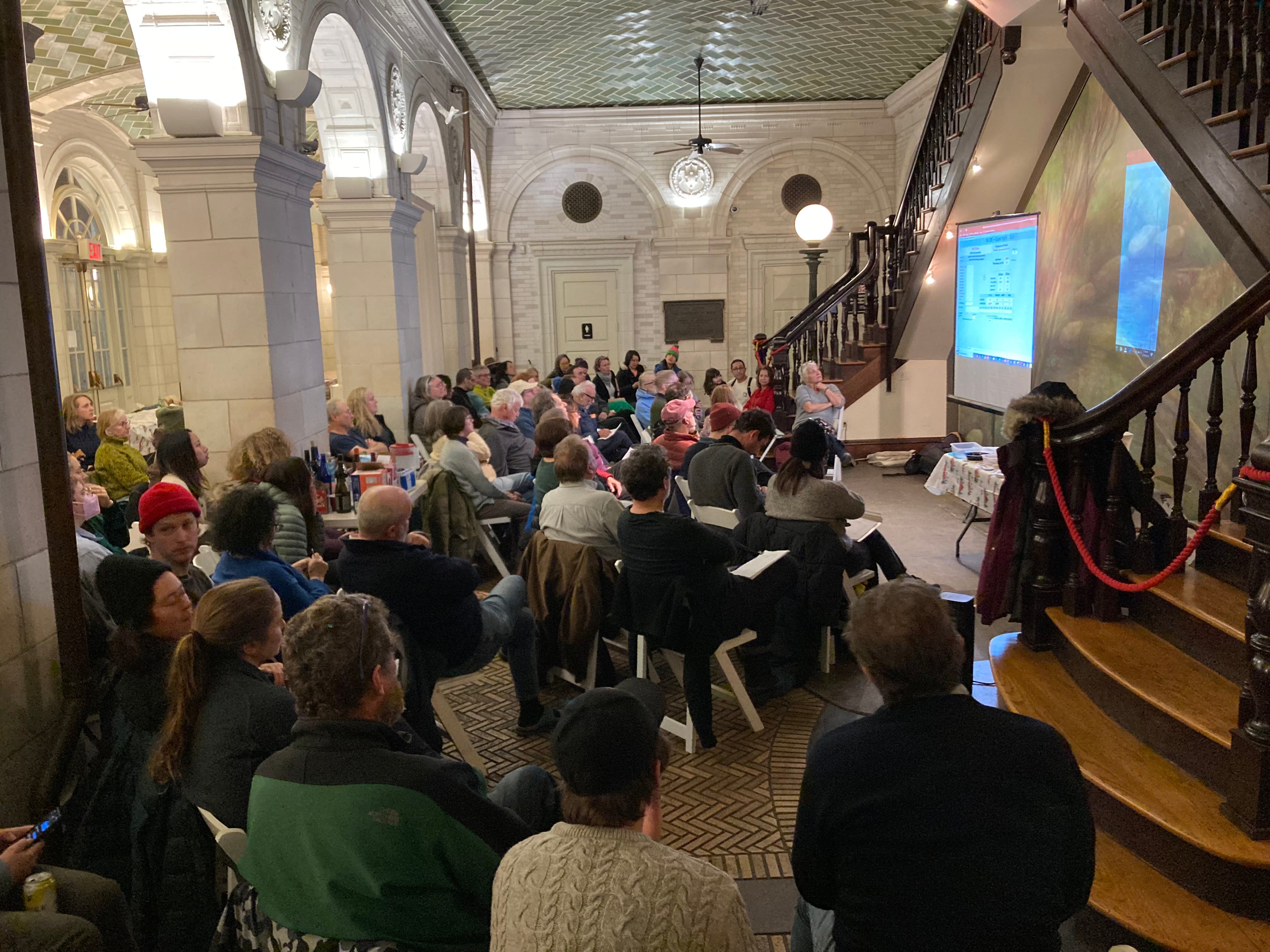
It’s an incredible event, part science, part community building. After a potluck dinner, we arrange our folding chairs around a projection screen and settle into an expectant silence. On the screen is the first slide of the night: snow goose. Starting in taxonomic order, the count compiler runs through every species from past counts, from common to irregular to rare, while team leaders call out their totals for each species. I usually keep my eye on the boat team throughout the night. It has a strong start, as water birds come at the beginning of the taxonomic order, but eventually it hits a dry patch and my Green-Wood team climbs out of last place halfway through the passerines.
We’re able to track this and other stats in real time, thanks to a unique database created in the 1980s by a Brooklyn Bird Club member named Rick Cech, who works for the Federal Reserve. I’ve done a few other Christmas counts over the years and nothing comes anywhere close to this presentation. It puts a stamp of professionalism on Brooklyn’s records and enables immediate comparisons to past records. Each slide includes historical and 10-year highs and lows, and an empty field for the new entries.
It’s powerful to see your experience in a larger context, transformed into scientific analysis before your eyes. Birds are environmental indicators, and their population trends on the CBC point to ecological changes—in Brooklyn, for instance, the loss of grasslands, as told by the downward trend of eastern meadowlarks, or the closing of landfills, as seen in the plunge in gulls, or a warming climate, from the increases of historically southern species like cardinals, mockingbirds, and titmouses. The slides also show that many common species are becoming harder to find.
Even if those numbers aren’t what they used to be, I’m glad I at least have a community to share the experience with. If you haven’t signed up yet, I encourage you to find a team here.
In Bird City news…
Next Wednesday, December 17 at 7pm, I’ll be giving a virtual talk about Bird City for NYC Bird Alliance, the first in its winter lecture series. All my previous talks have been in person—tune in and wish me luck!
I was on Anne Helen Petersen’s Culture Study podcast last week to talk about the growing popularity of birding and some changes in its culture thanks to apps like Merlin. As Anne says, though, the heart of the episode is discussing what makes people fall in love—and stay in love—with this hobby. I hope you’ll give it a listen and share with others. It was a fun conversation.
Finally, I’d be grateful if you could take a few minutes to write a quick review of Bird City on Amazon or rate it on Goodreads. Those help it reach a larger audience. Thank you!
I've been birding at the Charles H. Rogers Wildlife Refuge probably fifty times and never knew anything about the person it was named for. Very cool to learn that detail!